How a new voting system could end Labour’s grip on Newham

2 Feb

Forhad for Mayor.

Uma Kumaran MP on Instagram

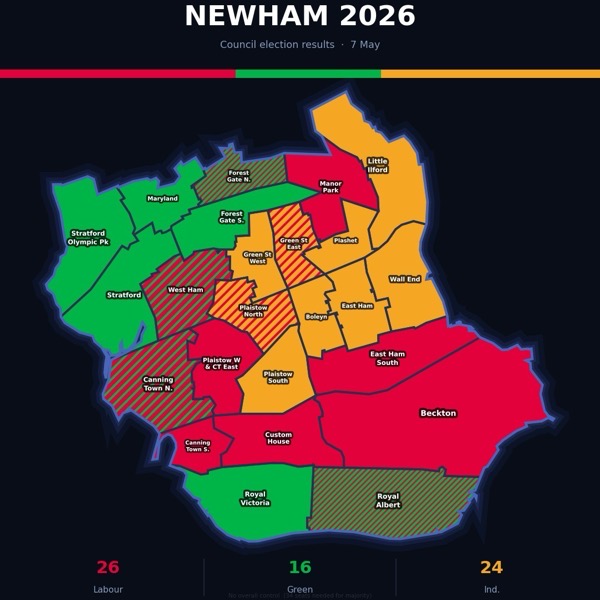
For decades, Newham has been synonymous with Labour dominance. The borough has consistently delivered some of the party’s strongest results anywhere in the country. But as we approach the May 2026 mayoral election, a perfect storm of a changed electoral system and political upheaval threatens to end that era.

The System That Protected Labour (though it rarely needed it)

Until now, Newham’s mayoral elections used the Supplementary Vote system, where voters could express both first and second preferences. If no candidate secured over 50%, second choices were redistributed between the top two. In practice, this rarely mattered — Labour won outright on first preferences in five of six elections. Only in 2006, when George Galloway’s Respect Party mounted a strong challenge, did Labour need second preferences to win.

Had the Tories not abolished this system in 2022 it would have provided Labour with a crucial safety net this year. Progressive voters could have backed the Greens or another party as their first choice, knowing they could return to Labour via second preferences. Even with Labour’s support weakened by the unpopularity of the Starmer government, the party would likely have benefited from transfers from other progressive voters keen to keep less appealing alternatives out.

That buffer has for the time being disappeared. Despite introducing legislation to reinstate the supplementary vote, parliament has not yet passed it into law, so the 2026 election will use First Past the Post. One vote, winner takes all, regardless of whether they achieve a majority.

Historical Strength, Meet Historic Weakness

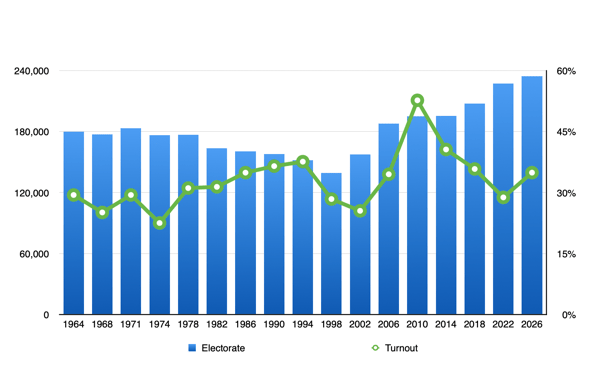
To understand how extraordinary the current situation is, consider the numbers. In 2018, Rokhsana Fiaz won with a commanding 73.4%. Even in 2022, when her support dropped significantly, she still secured 56.2%.

Historically, Newham Labour’s candidates have outperformed national polling by 25-40 percentage points. For example, when the party polled 29% nationally in 2010, their mayoral candidate won 68% locally. Newham has always been a Labour bedrock.

Fast forward to January 2026, and Labour is polling at a catastrophic 17-22% nationally — the party’s worst position since monthly polling began in 1983. Even with the usual level of out-performance versus the national party, Newham Labour may struggle to hit even 40% this time.

And with the early messaging from Labour candidate Forhad Hussain suggesting he is running against the current mayor’s record rather than the Opposition, that is doubtful. “Labour’s made a mess of it, vote Labour” is s hard message to sell.

The Challengers Emerge

Given the polls and the change to the voting system, this election is genuinely competitive.

The Newham Independents’ candidate, Councillor Mehmood Mirza, represents the largest opposition group on the council with four seats (or is it five?). His populist platform — council tax freezes, free parking, public events, even more free parking, and free sports gear for every child — taps into dissatisfaction over street cleaning, parking charges, and council governance, as well as anger over Labour’s stance on Gaza. Whether his ambitious spending promises can be delivered within a balanced budget is questionable, but the appeal is undeniable. Promises cost nothing, and by the time voters find out he can’t actually deliver them, it’s too late.

The Green candidate, Councillor Areeq Chowdhury, defected from Labour in 2024. His candidacy provides a direct bridge for disillusioned Labour supporters into another progressive option. The Greens already hold the Stratford Olympic Park ward and are targeting council seats in Stratford, Forest Gate and the Royal Docks. They came second with 17.4% in the July 2024 general election in Stratford & Bow, demonstrating organised support across the borough’s younger and more affluent areas. His promise to “ensure we have a clean, green place to live in” will resonate with those voters.

The central structural problem for Labour is that they and their main challengers sit broadly within overlapping political spaces. They share concerns about housing quality, street cleaning, regeneration, and accountability. Despite his regressive policies on climate and tax, Mirza enjoys the endorsement of Jeremy Corbyn, while the Greens have also attracted support on the Left with positive messaging on migration and calls for a wealth tax.

If Chowdhury attracts environmentally-minded and younger voters, while Mirza consolidates anti-establishment and community-based support, Labour’s vote could be eroded from two directions at once.

Reform UK adds another layer of complexity. Newham is not an obvious Reform stronghold. It is younger, more ethnically diverse, and more urban than the areas where Reform has typically done best. Its core base — older, white, socially conservative voters — is relatively smaller here. But the party’s emphasis on social conservatism and cultural issues may resonate with some older and more religious voters who feel detached from Labour’s current direction. Without much in the way of local campaigning infrastructure they secured around 17% in the recent Plaistow South by-election. Reform doesn’t need to win to make a difference because it draws votes from multiple pools: disaffected Labour supporters, residual Conservatives, and general protest voters. Ten or twelve percent could reshape the contest by lowering the threshold for victory.

The Fragmentation Factor

Put these elements together, and the outcome is unprecedented fragmentation and a potentially knife-edge result. Something along these lines is entirely plausible:

  • Labour: 32-40%
  • Newham Independents: 25-33%
  • Greens: 18-25%
  • Reform: 10-15%
  • Others: 5-10%

Labour might win with barely a third of the vote, meaning a large majority preferred someone else. Alternatively, if one challenger consolidates better or is more effective at turning out its vote, the party could lose out entirely.

The Irony of Simplification

Historically, Newham’s mayoral elections were about majorities – often big majorities. In 2026, they’ll be about pluralities. Labour’s dominance was built on strong first-preference support, reinforced by second preferences when needed. Under FPTP, only the first layer remains. Its proponents claim it’s a simpler system, easier to understand. Ironically, it could lead to a result that is more complicated and unpredictable.

For Labour, the task is clear but difficult: hold the vote together in an unfavourable national climate and prevent further defections. Their current strategy, focusing on parking and traffic management, is seriously puzzling. Why add salience to issues that Mirza is actively campaigning on and at the same time risk alienating younger and environmentally conscious voters, for whom the Greens are already an attractive option? 

For the challengers, the dilemma is opposite. Each has a case against Labour, but collectively they risk canceling each other out. Fragmentation may hand Labour victory by default.

Whatever happens, 2026 will produce a mayor backed by fewer people than any of their predecessors. In a borough long accustomed to clear mandates, that would mark a profound shift in how local power is won — and how legitimate it feels. Labour may be about to learn a harsh lesson about the vagaries of first-past-the-post in an age of political volatility.

Even Nur Confusion

22 Jan

Mere days after posting on Facebook about being a ‘neutral independent council candidate’ Nur Begum (Little Ilford) has done another about-turn, claiming to still be a Labour councillor.

But fellow (and genuinely Labour) councillor Alan Griffiths was quick to correct her. ‘No’ being the entirety of his reply.

Newham Living Streets

21 Jan
Join us for the launch of Newham Living Streets!
We’re excited to invite residents, local organisations and everyone who cares about safer, greener, more welcoming streets to the official launch of Newham Living Streets! Come along to learn about this exciting new initiative aimed at making walking, wheeling and everyday life in our neighbourhoods healthier and more enjoyable.
📆 Date: Thursday 29 January 2026
🕡 Time: 6:30 PM – 8:30 PM
🏢 Location: Canning Town Library, Rathbone Market, London E16 1EH
Book via the link below:
Hear from inspiring speakers working in transport, public health and community action, discover how you can get involved, and meet others shaping the future of our streets together.
Let’s make Newham’s streets safer, greener and better for everyone — see you there!
#NewhamLivingStreets #LondonCommunity #ActiveTravel #HealthyStreets
 

Even more independent

12 Jan

Nur Begum election leaflet

Leaflet posted to Facebook by Little Ilford councillor Nur Begum

Little Ilford councillor Nur Begum only crossed the floor to the Newham Independents in November, but it looks like she’s already moving on.

In a post on her Facebook page she describes herself as a ‘Solo Independent Neutral Councillor Candidate’.

Her ‘six point plan’ to Make Newham Great Again (seriously, councillor?) is a combination of Newham Independent gripes – parking charges (twice!), freezing council tax, free bulky waste collection – and actual Labour achievements like free school meals.

She says

Labour has presided over years of decline in our borough

while failing to mention that she sat for the better part of four years as a Labour councillor. 

She goes on

Unlike the big parties, I have only one priority: You. I will work tirelessly every single day to deliver the improvements that the Little Ilford deserves

Her defection to NIPs came after she failed to win re-election as a Labour candidate. Obviously I have no insight into why she was let go, but one might reasonably speculate that a failure to work tirelessly for her residents was a factor. 

Candidates assemble!

7 Jan

The three biggest parties in Newham politics have announced their candidates to replace Rokhsana Fiaz as mayor in May’s local elections.

Forhad Hussain and fellow Labour candidates

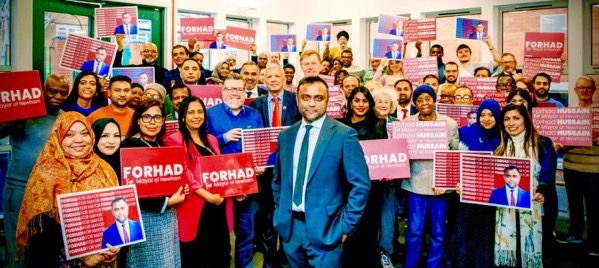
Labour’s candidate will be Forhad Hussain. Like all of the party’s candidates, he was selected by a special panel of the National Executive Committee. Hussain previously served as councillor for Plaistow North from 2010 to 2018 after standing unsuccessfully on the Respect ticket in 2006. He held a couple of positions in Robin Wales’ cabinet and chaired the audit committee. I’m not sure what he’s been doing politically for the past eight years, though as the local Labour parties have been suspended for five of them it’s perhaps not surprising his profile has been a bit low.

Newham Independents announce Mirza for Mayor

To absolutely no-one’s surprise the Newham Independents will be nominating Cllr Mehmood Mirza as their candidate. I’m afraid I couldn’t get a better picture as both Mirza and his party have blocked me from all their socials. Mirza has been councillor for Boleyn ward since winning a by-election a couple of years ago. He now leads a group of five councillors with, shall we say, diverse political histories (from Corbynites to Conservatives) but united by a sense of grievance with the Labour party and a penchant for owning multiple properties. Mirza was once a candidate for a seat on the party’s NEC and was vice-chair for membership of the West Ham constituency party before being suspended

Areeq Chowdhury, Green candidate for Mayor

Newham’s Green party was the official opposition on the council before Mirza’s party turned up. Their two councillors elected in Olympic Park ward were later joined by Areeq Chowdhury after he defected from Labour. Cllr Chowdhury has represented Canning Town North since 2022, where he was a late addition to the slate after a previously selected candidate was dropped.

There is a yet no word from the Conservatives, Liberal Democrats or Reform, but all are sure to put their hat in the ring. Maybe the Christian Peoples Alliance will have another go too. This post will be updated as and when.

Saving lives

17 Dec

Will Norman Newham.

Will Norman addresses Newham councillors

Dr Will Norman, the mayor of London’s Walking and Cycling Commissioner, spoke to Newham council at their October meeting about the impact that policies to reduce traffic and improve air quality have had. This is the speech he gave, lightly edited to improve readability online*.

Thank you, Chair, and a massive thank you to the whole council for inviting me here the this evening. It’s a privilege to be here.

I’m going to start on a somber note. Last year, 110 people were killed on London streets through crashes and collisions. Over 3,500 people were seriously injured in the last three years. There have been 15 fatalities on Newham’s roads, and over 4,000 people have been hurt.

Now you, as councillors, will know the tragedy that that brings to people’s families, to their friends, to colleagues and to communities. These are violent, random deaths that bring misery to thousands of Londoners on an annual basis.

The good news is that those numbers are falling.

Last year was the lowest year on record outside the pandemic for fatalities and London’s number of collisions are falling four times faster than the national average. And I’m here today to say thank you to everybody in this room for playing your role. Your rollout of a 20 mph limit across the borough has had an incredible impact.

We’ve done some research now looking at the impact that council decisions have made on the on the lives of Londoners.

We saw a 40% fall in fatalities thanks to your policies.

We saw 34% fall in the number of people being seriously injured thanks to your 20 miles an hour policies.

Astonishingly, we saw a 75% fall in the number of kids being killed on London’s roads due to your 20 miles an hour policies.

And there’s a huge amount of evidence of the benefits that these are bringing. They are not having an impact on journey times. They’re having an impact on air quality. They are saving lives, due to all your hard work.

There are literally people walking around Newham today who wouldn’t have been, had it not been for the efforts of everybody in this chamber.
It’s not just the 20 miles an hour that’s having an impact. If you look at your fantastic healthy street schools programme, it’s another success.

And I’d like to congratulate everybody in the room for their work on this too. 51 of your 127 schools have got us got a school streets program.

The evidence shows that you’ve seen a significant fall in the volume of traffic. The feedback from people within Newham means that it’s they feel safer and calmer to walk their school or their kids to school across the whole capital. Because of your hard work, we’ve beaten our target of 58% of kids to walk to school on a daily basis – which far exceeds the national targets – and it far exceeded our expectations. So we’ve had to set a new target because of all your good work.

But it’s not just that kids are safer going to school on their way to school and their way back. It’s having an impact in their schools.
I don’t know if any of you have ever seen a child have an asthma attack. It is genuinely terrifying seeing a small child struggling to breathe, to struggle to get air.

Our air quality contributes to that on a daily basis. So we put air quality monitors inside some of the schools around London to look at the impact.

SchoolStreets Cuts Pollution.

I’ll show you the benefits that your policies are having on children with these with the in these schools. The graph there shows that there is obviously an improvement in air quality at drop off time and pick up time. Now that would make sense, because that’s when the school streets in operation. But the genuine change that that graph shows is that air quality throughout the entire school day is better, not just a drop off time, not just a pick up time.

That means that every school, every kid in those 51 schools across Newham is breathing in cleaner air the whole time they are at school.

So again, thank you, that is also contributing to the change in air quality across London. That means fewer asthma attacks and all the problems associated with that across the city.

When we started this journey, I think we were told it would take 194 years to make London’s air legal. Can you believe that almost 200 years to make London’s air legal?

Collectively, thanks to the work in this of everyone in this room and at Transport for London and the mayor and all the other boroughs, we’ve done that in nine.

So thank you. You are saving lives on that. But it’s not just road safety, it’s not just air quality. The health benefits of the policies that you’re implementing are having an astonishing impact.

I was talking to Chris Whitty, the Chief Medical Officer for the UK, the other day. He said that active travel is having more of an impact than anything else on the outcomes and inequalities in health.

Last week, I was out with the Mayor and Councillor Morris to open the new bike lanes and transformation of the North Woolwich corridor. We heard from secondary school kids who were walking to school safely. We saw cyclists moving along there safely, and that is contributing to a huge boost in cycling across London.

You collectively in this room, are making kids healthier. You’re stopping those asthma attacks, you’re reducing heart disease, you’re reducing diabetes, you’re reducing cancer, you’re reducing depression, you are contributing to a healthier London, a healthier Newham, and everybody is benefiting from that.

So I remind you again, as a consequence of your hard work, there are people walking around this borough today, right now, this evening, who wouldn’t have been had it not been for the policies you’ve implemented. So I want to say, on behalf of the Mayor of London and on behalf of the residents of London, thank you.

Keep up the good work.

We’ll keep supporting you, but the impact that you are making is genuinely astonishing, and you should be proud of it.

The long and short of it is that policies that discourage unnecessary car journeys and encourage active travel SAVE LIVES. Better air quality means better health. Fewer cars on the road means fewer collisions, fewer injuries, fewer deaths. 

In next year’s elections some candidates will stand on a platform of rolling these policies back. They will claim to be speaking for residents, for ‘the people’. But evidence shows that doing so – cancelling healthy school streets, rolling back people friendly streets, reverting to a 30 MPH speed limit – will cost lives. People who are walking around our borough today won’t be in a year or two if we step back into the past.

Please, think carefully before you vote.

So long, farewell

8 Dec

Mayor Rokhsana Fiaz

Mayor Fiaz will be among those departing after the elections in May

The panel tasked by Labour’s national executive to oversee the election of candidates for next May’s elections has completed its work. While we don’t yet have official confirmation of the successful applicants, there are a number of sitting councillors who will be leaving the Labour benches next year:

  • Rokhsana Fiaz, Mayor of Newham since 2018; previously councillor for Custom House
  • Dr Rohit Dasgupta, councillor for Canning Town South since 2018; chair of council and First Citizen of Newham
  • Alan Griffiths, councillor for Canning Town South since 2014, previously represented Park, Forest Gate South and Plaistow North
  • Charlene McLean, cabinet member for Resident Engagement & Resident Experience; councillor for West Ham since 2018, previously Stratford & New Town
  • Simon Rush, secretary of Labour Group; councillor for Plaistow West & Canning Town East since 2022
  • Amar Virdee, councillor for Green Street West since 2022
  • Stephanie Garfield, councillor for Wall End since 2023
  • Joshua Garfield, councillor for Stratford (previously Stratford & New Town) since 2018 
  • Jemima McAlmont, councillor for Wall End since 2022
  • Mohammed Muzibar Rahman, councillor for Green St East since 2022
  • Sarah Ruiz, Deputy Mayor & Cabinet Member for Children’s Services, Education & Sustainable Transport; councillor for Custom House since 2018, previously South, Beckton and Royal Docks
  • Rita Chadha, Cabinet Member for Health & Adult Social Care and Transforming Newham for the Future; councillor for Canning Town North since 2022
  • Anamul Islam, formerly Labour Group chief whip; councillor for Forest Gate South since 2022, previously Forest Gate North
  • Dina Hossain, councillor for Plaistow West & Canning Town East since 2022
  • Carleene Lee-Phakoe, councillor for Plaistow South since 2018
  • Pushpa Makwana, councillor for Plashet since 2018
  • Terry Paul, councillor for Stratford (previously Stratford and New Town) since 2010
  • Winston Vaughan, councillor for Forest Gate South since 2002, previously New Town
  • Dr John Whitworth, Cabinet Member for Air Quality, Climate Emergency & Environment; councillor for West Ham since 2014, and previously 2002 to 2006
  • Nur Begum, councillor for Little Ilford since 2022, sitting as a Newham Independents Party councillor since learning of her deselection

Of course, there are four other councillors who were elected for Labour in 2022 who no longer have the whip. Belgica Guana (Canning Town South) and Lewis Godfrey (Green Street West) sit as ungrouped independents; Areeq Chowdhury (Canning Town North) is now with the Greens and Zuber Gulamussen (Plashet) is the chief whip for the Newham Independents.

Remembering Neil Wilson

25 Aug

Cllr Neil Wilson at Curwen Primary School

Newham lost one of its most devoted public servants on July 30th, 2025, with the passing of Councillor Neil Wilson, known affectionately as the “Father of the Council.” A by-election to replace him will be held on September 18th.

Neil Wilson’s journey into local politics began in the early 1990s. After an unsuccessful bid in South Ward (now East Ham South), Wilson found his political home in 1994 when he was first elected to represent Hudson’s Ward. The ward would later become Plaistow South following boundary changes. For the next 31 years, Wilson served the area where he lived, embodying the important principle of local representation. 

In the administration of Sir Robin Wales, he held the Equalities portfolio. More recently, under Mayor Rokhsana Fiaz, he served as Cabinet Member for Health and Adult Social Care.

Wilson’s High Anglican faith was a cornerstone of his life and politics. He was a regular worshipper and trustee at St Alban the Martyr in Holborn and a member of the Society of Sacramental Socialists.

By-election

The contest to fill Wilson’s seat has attracted candidates from all five national parties, plus the local independents. The six candidates standing are:

  • Asheem Singh – Labour Party
  • Md Nazrul Islam – Newham Independents Party
  • Rois Miah – Local Conservatives
  • Sheree Miller – Liberal Democrats
  • Lazar Monu – Reform UK
  • Nic Motte – Green Party

This by-election comes at a tricky time for Newham Labour. The three local constituency parties remain suspended and a new candidate for mayor, Forhad Hussain, has been selected for next year’s elections.

Recent by-election losses in Plaistow North and Boleyn, plus the 2022 defeat to the Greens in Stratford Olympic Park have raised questions about Labour’s grip on the borough. A victory in Plaistow South would demonstrate resilience despite recent controversies, while a defeat could signal deeper challenges ahead of the 2026 campaign.

A lasting legacy

As voters prepare to choose Wilson’s successor, they face the challenge of replacing someone with deep institutional knowledge, a profound commitment to social justice and a determination to do through best for his constituents. 

Wilson served for 31 years, but his legacy extends beyond mere longevity in office. Wilson represented a style of local politics rooted in community connection, principled governance, and genuine public service. His commitment to equality, his role as a mentor to newer councillors, and his unwavering dedication to his community set a benchmark for public service.

The candidates vying for his seat will each bring their own vision for Plaistow South’s future. However, they will all be measured, in some way, against the standard of service that Neil Wilson established over more than three decades of dedicated public service.

On September 18th, residents of Plaistow South will not just be choosing a new councillor – they will be selecting someone to carry forward the democratic tradition that Neil Wilson served with such distinction.

Unmesh Desai cleared after police investigation

13 Jan

Unmesh Desai signis in as London Assembly member

Police will take no further action, but Desai remains suspended by Labour

A police investigation involving London Assembly member Unmesh Desai has concluded with no further action to be taken, according to a statement released through his solicitor last week.

Ali Parker of Saunders Law issued the following statement on Mr. Desai’s behalf:

Between late December 2024 and today, I was the subject of a police investigation. I have not made any public comment on this until now.

I cooperated fully with the police investigation. I answered all of the police questions in interview, maintaining my innocence without any legal advice.

I have today been informed that police are taking no further action in my case. I have always maintained my faith in our system of justice and in the Metropolitan Police.

I have however been saddened that certain media outlets, political bloggers and users of X (formerly Twitter) have linked my name to this investigation before I was ever charged with any offence.

Allegations like this spread like wildfire across the internet. In my case, there were very good reasons for pre-charge privacy. It is not right that my name has been tarnished in this way.

The Labour politician, who was first elected to the Assembly in 2016, represents the City & East Assembly constituency, which includes Barking and Dagenham, City of London, Newham and Tower Hamlets. He currently sits on several important committees including budget and performance, transport, and police and crime. He served as a councillor in Newham from 1998 to 2018, holding a number of cabinet positions in Sir Robin Wales’ administrations.

During the investigation, the Labour Party placed Desai under “administrative suspension,” requiring him to temporarily sit as an Independent at City Hall. The suspension remains in effect pending resolution of a related complaint within the party. Desai has not said whether he would be challenging his suspension from Labour and the party has not commented on whether it will now lift it in the light of the Police decision.

The Metropolitan Police will not comment on the reason for the arrest. This aligns with a general rule, confirmed by the Supreme Court, that a person under criminal investigation has, prior to any charge being brought, “a reasonable expectation of privacy.


UPDATE (2 April 2025): Unmesh Desai has been re-instated by the Labour Party and is again sitting as a member of the Labour Group on the London Assembly.

Elevated to the peerage

20 Dec

Lyn Brown, who stood down as MP for West Ham at the last general election, has been appointed to the House of Lords.

The full list of political peerages is here.

Many congratulations, Lyn!